
I didn’t expect a book club meeting about Ann Patchett’s latest novel, Whistler, to end with an invitation to fight in the parking lot. Perhaps that’s a failure of imagination on my part. Or perhaps it’s a testament to the unexpected joy of book clubs and the way discussion transforms literature.
For 11 years, I’ve been running the First Draft Book Club at Changing Hands Bookstore. How quaint, right? You’re likely imagining a dozen ladies sitting in a circle, some with knitting in their laps. Maybe half have finished the book and the other half showed up anyway for the company and an excuse to get out of the house.
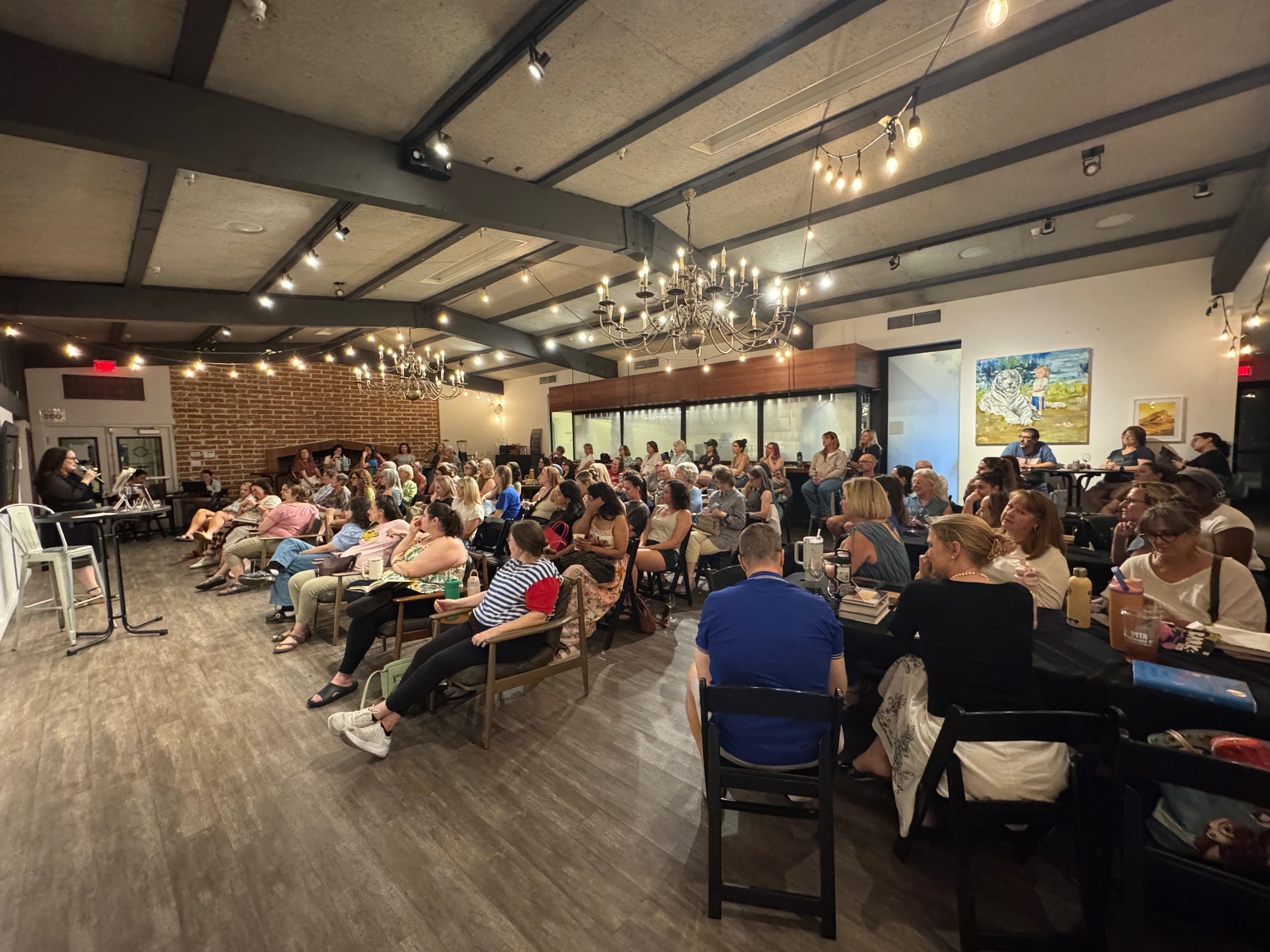
But I want you to look at the photo above. My friend Jason tried to count the people in the room that night, the last Wednesday of July, and lost track at 120. That’s 120 real, live human beings who got in their cars and drove to uptown Phoenix on a Wednesday night, fought for parking spaces in a cramped lot, stood in a line that snaked to the door for a glass of wine, and sat for close to 90 minutes touching shoulders with the people next to them to throw down over Ann Patchett.
It was the most bonkers book club meeting I’ve ever moderated, and I’ve moderated a fair few: 133 since the book club launched in 2015, skipping one month when the COVID-19 pandemic hit and we were trying to figure out how to go virtual, if my math is right (never trust my math). My earliest misstep was assigning everyone to read Otessa Mosfegh’s Eileen in December of 2015, as bleak and unChristmas-y a winter book as ever has been written. That was a spicy meeting and a lesson in reading the room as much as the book.
Anyway, back to Whistler. The first 30 minutes or so of the discussion were business as usual. Patchett is in a reflective mood, and Whistler, like Tom Lake, is about a woman revisiting her youth in life’s golden hour. Daphne, a charming, mild-mannered creative writing teacher in her 50s, happily married many years to an older man left widowed by his first wife, has a chance encounter at the art museum with Eddie, her erstwhile stepfather. She’d only known Eddie for a few years of her youth - Eddie, her mother’s second of three husbands, who left her life as suddenly as he’d entered it, had been a soul mate of sorts; whatever souls are made of, theirs were the same. And then they got into a car accident, a bad one, at night while on a side quest to look at the stars. The two were left stranded in a tree, a few of Eddie’s important bones crushed in the dark and freezing cold, decades before the advent of cell phones.
They made it out of the car alive, though Eddie’s marriage to Daphne’s mother did not - she filed for divorce and remarried shortly after. Everyone seemed to move on. Now, late in Eddie’s life and midway through Daphne’s, there’s an unexpected chance at reconnection.
We were having a perfectly lovely conversation about this perfectly lovely book - a conversation about love, memory, found family, and platonic soul mates. But then a man named Alex raised his hand.
(Spoilers ahead if you haven’t finished Whistler, though I don’t think this is a book one can spoil, despite the nature of the argument that follows.)
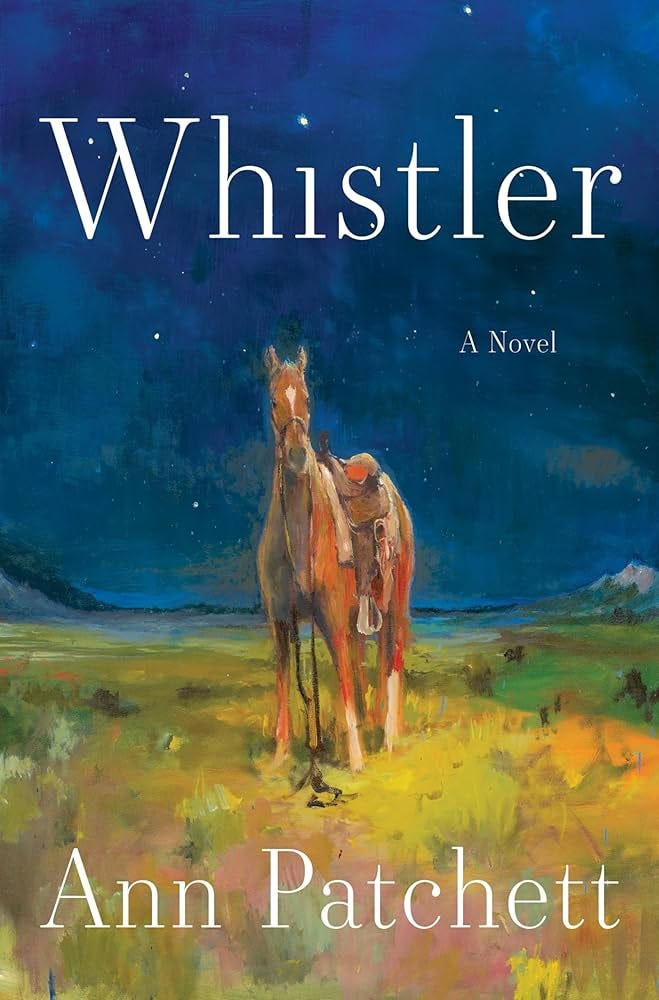
Towards the end of the book, it is revealed that Eddie has cancer. Daphne dutifully attends chemotherapy with him, and Eddie makes Daphne promise to write their story as a book, to immortalize the two of them and their love for each other, and to end the story just here - talking over chemotherapy - so that he never has to die.
What if, Alex said, Eddie wasn’t dying of cancer at the end of the book. What if Eddie was already dead? What if he died in the car that night, his leg crushed, his body temperature plunging? What if little Daphne never made it in time for help? What if Eddie’s suggestion at the end that Daphne immortalize him in a book - presumably the book we, the readers, are engaged in conversation about right now - isn’t about a version of him surviving cancer, but surviving the car crash?
The room erupted. I mean, erupted. People were screaming (in a good way, but still, screaming). I asked for a show of hands: How many of the 120 people in the room thought Eddie died in the car that night? Apart from Alex, only one woman raised her hand - confidently, because she had brought receipts. There was that weird conversation, she said, Daphne and Eddie had about the concept of the Bardo, about souls trapped in transition.
The room plunged further into chaos.
We stayed almost a half-hour past the book club’s end time to keep unpacking Alex’s crazy theory, which was feeling less crazy with each passing minute. I asked for another show of hands at the end of the conversation - how many people had been converted to Alex’s cult? Twenty-ish hands went into the air.
“Alex, we’ll see you in the parking lot after this is over!” someone (jokingly?) threatened.
In an interview with Elle about Whistler, Patchett spoke about her warmhearted writing of stories about good people trying their best to be good to one another - an approach sometimes criticized as saccharine. “I can watch the news; I can read the paper; I can know that terrible things are happening everywhere,” Patchett says. “But in my life, everybody’s so nice. In the bookstore, in my house, in my neighborhood, in the grocery store, people are kind to one another.”
We can argue about the merits of kind lit-fic and whether it offers enough meat on the bone. But the reason the room erupted that night and a book club meeting almost ended in fisticuffs is because Patchett succeeded in her literary goal. Not in pulling the rug out from under the reader with a plot twist (I still disagree with Alex, though I appreciate the lunacy he injected into the night’s festivities) - but in creating a kind character so real feeling, a room full of readers was plunged into despair at the far-fetched suggestion of his untimely death. The depth of love for Eddie in the room that night was palpable. Eddie! A fictional, mild-mannered book editor who likes a bit of white wine in the early afternoon. For this man, my book club called for muskets at dawn.
Patchett had made us fall in love with one of her inventions. I can’t think of any higher art than that.
Wow what a fun group. Can that guy please destroy Theo of Golden too? Pleeeease.
I love this! And now I’m tempted to re-read!
(You should write to Patchett and tell her! I wrote her a letter (to be fair, before The Correspondent) and she replied.)